12/18/10

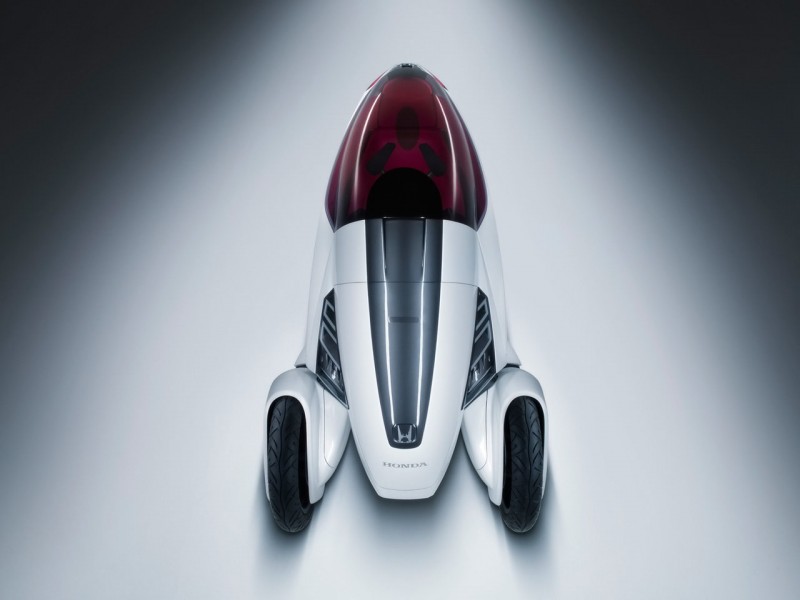
Honda 3R-C concept World Debut at Geneva International Motor Show 2010

Auto Car | Honda 3R-C concept World Debut at Geneva International Motor Show 2010 | The Honda 3R-C, a revolutionary one-person battery electric vehicle concept, will make its world debut in Geneva alongside the EV-N concept, to be displayed for the first time in Europe.

Both the three-wheeled 3R-C concept, which envisions a single occupant vehicle for zero emission commuting, and the EV-N urban concept, draw on Honda's vast working knowledge of vehicles utilising electric motors.

This revolutionary three wheeled battery electric vehicle concept shows what a future minimal urban transport vehicle for one person might look like. The battery electric drivetrain is mounted low in the three wheeled chassis, therefore keeping the centre of gravity low and thus improving stability.

The 3R-C has a clear canopy that covers the driver's seat while it is parked and not in use. When 3R-C vehicle is in motion, the canopy becomes an enveloping wind-shield that provides the pilot, who sits low in the vehicle, with significant protection from the bodywork and doors.

The high sides of the safety shell seat give greater safety to the occupant, reducing the threat from side impacts and improving weather protection. In front of the driver is a lockable boot area, which gives significant secure storage for luggage or other items. The 3R-C's designers created a flexible cover that surrounds the upper torso to reduce exposure to bad weather and improving comfort.

The 3R-C study was created by European designers working at Honda's Research and Design facility in Milan.

Ask anyone who's ever shopped for an ATV, outboard engine, personal robot...heck, even a private jet, and they'll tell you that cars are only the tip of the proverbial iceberg for Honda. The Japanese industrial giant is one of a handful of automakers that also makes motorcycles (along with the likes of Peugeot, BMW and Suzuki, to name just a few). And here in Geneva, the two core competences have come together in the form of the 3R-C Concept.

Packing two wheels up front and one in the back, the 3R-C is the latest take on the trike formula. The open cabin (which can be closed by the canopy windshield when parked) can accommodate one passenger/driver/rider in enclosed comfort, while the twin front rims keep it stable. It follows in a long line of intriguing R&D products from the technological powerhouse, but don't expect to see it parked curbside in front of your office/home/biker bar quite so soon.

The array of conceptual urban cruisers from Honda continues, as the automaker released photos of its new 3R-C concept, which will debut at next week’s Geneva motor show.

While the P-NUT concept was the brainchild of Honda’s American R&D styling studio, the 3R-C was designed and developed solely by the company’s European studio in Milan, Italy. Billed as a “minimal urban transport vehicle,” it’s hard to call the 3R-C a concept car, as the one-passenger, three-wheeled design study blurs the line between microcar and scooter.

Although it appears to have a translucent canopy in these pictures, it only shields the cockpit when the 3R-C is parked. In normal operation, it rotates upright, serving as a windshield and air deflector. Designers wrapped the “safety seat” in bodywork, helping protect the driver from debris and traffic. We’d imagine a helmet would be requisite, and conveniently enough, the 3R-C sports a locking trunk, large enough for such gear or small luggage.

Power, we’re told, comes from a battery-electric driveline mounted low in the chassis, but Honda provides no details nor indicates if the concept is actually functional. We’ll hopefully learn more come March 2, when the press days in Geneva kick off. Stay with Automobile Magazine for all the latest from the Swiss motor show.

 
Source : benzs.blogspot.com
Read More..

2011 Honda CR-Z Sport Hybrid Coupe Makes Official Debut

Auto Car | 2011 Honda CR-Z Sport Hybrid Coupe Makes Official Debut | The all-new 2011 Honda CR-Z sport hybrid coupe, making its U.S. production debut at the North American International Auto Show in Detroit, introduces sleek styling and sporty handling to the hybrid segment, American Honda Motor Co., Inc., announced today.

"The CR-Z is a personal sport hybrid coupe for people with a spirit of adventure and an elevated sense of responsibility toward the environment," said John Mendel, executive vice president of sales for American Honda. "It's the first hybrid designed to maximize style and fun, in addition to efficiency and economy."

Set to go on sale late summer in the U.S., the CR-Z is powered by a 1.5-liter i-VTEC engine with Honda's compact and lightweight Integrated Motor Assist (IMA) hybrid-electric system. The two-passenger CR-Z introduces a new three-mode drive system that allows the driver to select between Sport, Econ (Economy) and Normal driving modes.

The exterior's distinctive "one-motion" wedge form originates from its low-slung hood to form a broad forward stance. A side profile with a deeply inset beltline conveys a dynamic tension, while the short wheelbase and large, wide front grille accents the vehicle's athletic presence.

The futuristically styled interior offers a high-tech appearance and ergonomically intuitive controls. Instrument panel meters illuminate with a three-dimensional, vibrant blue color theme resulting in a multi-layered appearance. Set against a motif of textured black materials and aluminum-style trim accents, the upper portion of the dashboard extends toward the driver to provide a wrap-around cockpit environment. The passenger zone offers an open, comfortable space. Premium sport-oriented cloth seats are designed to provide excellent lateral support along with everyday driving comfort. A mid-ship console behind the front seats optimizes cargo space. A hard-shell separator can be closed to create additional hidden storage.

The two trim levels include the well-equipped CR-Z and the feature-rich CR-Z EX. A six-speed manual transmission is standard equipment and a Continuously Variable Transmission (CVT) is available. Standard features on the CR-Z include Vehicle Stability Assist, an AM/FM/CD/USB audio system with six speakers, automatic climate control, power windows and door locks, remote entry, cruise control, and more. The CR-Z EX adds, High-Intensity Discharge (HID) Headlights with Auto-On/Off, fog lights, a 360-Watt AM/FM/CD premium audio system with seven speakers including subwoofer, Bluetooth® HandsFreeLink®, perforated leather-wrapped steering wheel, center console with an armrest and storage compartment, and more. The CR-Z EX is available with the Honda Satellite-Linked Navigation System[1] with voice recognition.

The CR-Z represents the sixth unique version of Honda's original IMA technology since the launch of the 2000 Insight, the first hybrid vehicle available in North America in December 1999. The foundation of the CR-Z's hybrid powertrain is a 4-cylinder, 16-valve, single overhead cam engine with "intelligent" Variable Valve Timing and Lift Electronic Control (i-VTEC) that receives additional power from the IMA system's DC brushless electric motor. The i-VTEC system controls the opening and closing of one intake valve per cylinder to enhance combustion at low RPMs. The 10-kilowatt electric motor assists in acceleration and also acts as a generator during braking or coasting to capture kinetic energy that recharges the 100-volt IMA nickel-metal hydride battery pack. The gasoline engine can automatically turn off during vehicle stops to improve efficiency.

The system delivers a combined peak output of 122 horsepower[2] at 6,000 rpm and 128 lb-ft. of torque2 at 1,000 to 1,500 rpm (123 lb-ft on CVT-equipped models). Preliminary fuel economy estimates are anticipated to result in a rating of 36 city/38 highway miles per gallon[3] on CVT-equipped models. Manual transmission models are anticipated to achieve an EPA-estimated fuel economy rating of 31 city/37 highway miles per gallon3. The CR-Z is rated as an Advanced Technology Partial Zero Emissions Vehicle (AT-PZEV) in states that adhere to California Air Resource Board (CARB) ZEV standards (EPA Tier 2, Bin 2 in all states).

The standard six-speed manual transmission is engineered for optimal acceleration performance in gears one through five and for optimal fuel economy in sixth gear. When starting on steep inclines from a stop, hill start assist temporarily prevents the vehicle from rolling backwards during the moment between releasing the brake, depressing the throttle and releasing the clutch (for a duration of approximately 1.5 seconds). The available CVT provides the convenience of an automatic transmission with a seamless transition between minimum and maximum ratios, while also keeping the engine within an optimal RPM range for overall efficiency. To increase the performance potential of the CVT, paddle shifters located on the steering wheel allow the driver to manually simulate the stepped holding pattern. In Sport mode, the paddle shifters will hold and maintain a selected ratio.

The CR-Z's three-mode drive system allows the driver to select between individual modes of performance for Sport, Normal and Economy driving styles. The system is activated via three backlit buttons to the left of the steering wheel.

The Sport mode enhances multiple vehicle systems for performance including the engine throttle responsiveness, electric power steering effort and the electric motor power assist. The inner ring of the tachometer illuminates red when the vehicle is in Sport mode.

During Econ mode operation, the engine's responsiveness is tuned for optimal economy, the electric motor assist gives priority to fuel efficiency and the air conditioning system can reduce its overall load on the engine. The inner ring of the tachometer transitions between blue and green when the vehicle is in Econ mode, with the green representing more ecological driving.

Normal mode provides standard settings for steering, engine response, motor assist and air conditioning. The tachometer ring remains blue in normal mode. Like the Honda Insight, the CR-Z offers an Eco Guide and Eco scoring feature to help drivers track progress of efficient driving styles.

The front MacPherson strut suspension and rear H-shaped torsion beam suspension settings are tuned to provide a sporty, solid and dynamic driving experience. All models are equipped with 16x6-inch aluminum wheels with 195/55 R16 86V tires. Accessory 17x7 alloy wheels with 205/45R17 84V tires with are available. The standard anti-lock braking system (ABS) with electronic brake distribution (EBD) uses ventilated front discs and solid rear discs. The low vehicle height and placement of the battery and other hybrid components beneath the rear cargo area further contribute to a low center of gravity, which is key to the new CR-Z's responsive, sporty handling. Electric power-assisted rack-and-pinion steering enhances steering performance and improves efficiency.

In addition to being environmentally responsible, the CR-Z demonstrates a commitment to safety in its design and construction. The Advanced Compatibility Engineering™ (ACE™) body structure helps protect vehicle occupants in a frontal collision. Additional safety technologies include standard dual-stage, multiple-threshold front airbags; standard front-side airbags with passenger-side Occupant Position Detection System (OPDS); side-curtain airbags, active head restraints; an anti-lock braking system; a tire pressure monitoring system; and a pedestrian injury mitigation design in the front of the vehicle.

[1] The Honda Satellite-Linked Navigation System™ is available on the CR-Z EX in the United States, except Alaska. Please see your Honda dealer for details.

[2] Preliminary estimate provided by Honda. Final specification is subject to change.

[3] Preliminary EPA mileage estimates determined by Honda. Final EPA mileage estimates not available at the time of printing. Use for comparison purposes only. Do not compare to models before 2008. Your actual mileage will vary depending on how you drive and maintain your vehicle.

Source : www.reality-check.ca
Read More..

King Motorsports Mugen Honda S2000

Auto Car | King Motorsports Mugen Honda S2000 | The number of Formula 1 engine builders selling tuner parts to the public can be counted on one hand, and just two of those sell parts in the U.S.: Ferrari and Mugen. In other words, for those who worship at the altar of Honda performance, Mugen fabricates the kneepads.

King Motorsports, the official U.S. importer of Mugen products, bolted together this S2000 for the 2003 SEMA show in just more than a month. Unlike most thrown-together SEMA cars, however, this one actually works. Excitement accompanies every entry into the cockpit.

Tear ass down the block, and you think to yourself, "Wow, this car is really fast." But that's just the soundtrack. The S2000 begs you to rev the snot out of it, and those tricky Mugen engineers figured out how to make 8000 rpm sound more like 10,000. In other words, it sounds like you're driving an F1 car, which ain't a bad thing. During even typical low-rpm driving, between the Mugen intake and exhaust, the 2.2-liter sounds like there's a really pissed swarm of feminist wasps trapped under your right foot. It's a feature that doesn't get old.

That intake is a gorgeous carbon-fiber unit that draws fresh air from the car's snout, while giving you an excuse to get a Mugen hood (bulged to clear the intake) and bumper (fresh air duct built right in). The stainless-steel header is, of course, sculpture, and saves 10 pounds. The terminus of the bettered breathing system is an SS exhaust, which features stainless tubing and titanium cans, and weighs a full 25 pounds less than the stock system.

Despite such sexy hardware, on the dyno the car showed no improvement over the last stock S2000 we tested. In fact, it recorded less horsepower until 6600 rpm than the last stocker we tested and less torque than the stocker until 6500 rpm. At 6700 rpm, it begins to match the output of the stock car, and eventually peaks out at 148 lb-ft of torque, or two better than stock, and the same 210 hp. While not impossible, it seems unlikely that Mugen would sell products that don't make power. The other possibility is that the press car we tested back in the March 2004 issue was a ringer. It did make 10 more hp than advertised, and Honda has been known to have, ahem, healthy vehicles in its test fleet.

According to Scott Zellner from King Motorsports, the specially designed bumper and hood don't just look good, they help guide air into the intake for a ram air effect at speed, which doesn't show up on the dyno. But it may have at the track. The car did run four-tenths of a second quicker than stock in the quarter mile, running 14.0 sec. at 101.3 mph. This was also surely due to the extra person's worth of weight that was removed from the car by using the Mugen parts.

Rather than strip the S2000 to a shell to shave mass, Mugen used its extensive F1 experience to produce a body kit in gorgeously conceived and executed carbon fiber. The vented hood-which, incidentally, costs $2,600-looks like it was lifted from a LeMans car. As most people will paint the rear SS bumper,hiding the beautifully laid carbon weave, Mugen made sure to include a little integral anodized titanium Mugen badge so people know you paid a lot of money. The schnoz also features an aerodynamic undertray and a magnetic attraction to curbs and cement parking blocks. It's impossible to drive this car and not ding up its front end.

King also stuck on a CF wing from Mugen, pulled out the convertible top to save 60 pounds and replaced it with a $4,900 carbon hardtop. Guffaw if you must at the price, the visual appeal of the two-seater is undeniable. It looks different, serious and expensive all at the same time. Park it at a strip mall, and dozens meander over to ogle. Pull past the Honda boyz on the freeway and watch them drool inside their fartcan buzz boxes. We're not sure if the minion's attraction to the car is because of its salmon trout paint scheme or in spite of it, and we don't care. It's a head-turner.

It's also a back-breaker. Before you drive this car you must fold yourself into it. You start by placing one hand on the center console, one on the rocker sill, and swinging both legs in front of you. Then you use one hand to lift your balls out of the way, and the other to slowly lower yourself into the very narrow Mugen fiberglass bucket seats, which grab your ass like a vice. Once in, there's no moving. You've become part of the car.

Although fantastic for hard driving, those seats are the S2000's Achilles' heel. They have the padding thickness of a Maxi Pad, so your spine basically becomes part of the car's suspension. It's like commuting in a shifter cart. And if your waist is larger than a 34, forget it. Take the bus.

Still, there are few better things than putting on this car and hitting the mountains. Sitting low, locked and loaded, you engage the streetable Mugen Stage 1 clutch, which consists of a heavier-duty pressure plate, and the car is quickly at speed. Toggle the pedals, positioned perfectly, to select second gear coming into a sweeper. Dip into the brakes, and trail the middle pedal just a bit to transfer more bite to the front tires. Off the brakes, give the car more steering angle, and feed in the F22's eager noise. Progressively add throttle, easy now, and plant the pedal past the apex, which the S2000 seems attracted to by magnetic force. Unwind the wheel, letting VTEC work its magic, and the car tracks out, all four contact patches singing backup. It's like the S2000 doesn't know the word "understeer," but never supplies enough oversteer to bite you. Turn after turn. Pass after pass. For an hour. A grin flashes at you in the rearview mirror.

The stretches of road on which the accompanying pictures were taken are an inspiring combination of smooth, fast, open sweepers, blind crests and tight hairpins. As happens when the driving experience is good, really good, the Mugen S2000 disappears, leaving the driver, road and physics to dance.

Our testing numbers back up the car's handling prowess. Equipped with Bridgestone Potenza S03s, 215mm wide in front and 245-mm in the rear on staggered, forged 17-inch wheels, the S2000 pulled .99 g on the skidpad, and ran 73 mph through the slalom. Impressive, considering most cars that run similar numbers are using R-compound tires.

Mugen teamed up with Showa, which is known for its OEM and racing motorcycle suspensions, to design the NZ coil-overs. Compression and rebound are adjusted simultaneously and they're full-body adjustable to supposedly ensure travel is not compromised at lower ride heights. The Mugen coil-overs, however, did not like what Los Angeles city streets had to give them. Like a stock S2000, this one doesn't like bumps, especially when the suspension is loaded during a turn. It's livable, but only for the hardcore.

Although the whole package is not a reasonable daily driver for most, the extremely willing F22C, combined with highly tuned Mugen footwork, make this car a truly stellar smooth, winding-road companion. In terms of absolute numbers, however, we find it interesting the Mugen S2000 performed near identically to the NISMO R-tune 350Z we tested last month. Despite being another "swipe your credit card down the middle of the catalog" tuner special, the Z proved far more livable day to day.

If you think livable is for soccer moms, bust out the Mugen catalog. You'll find every part on the car in it, including the supercool hardtop and those ridiculous seats. Total tally? More than $25,000. Salmon trout paint scheme not included.

Source : www.modified.com
Read More..

Metra ElecTrick Civic ; Metra's Extreme Honda Civic Show Car

Auto Car | Metra ElecTrick Civic ; Metra's Extreme Honda Civic Show Car | This 1994 Honda Civic might look extra terrestrial, but it is of this earth. In fact, it was built in Holly Hill, FL. It started as a humble Honda, with parts from a Nissan and Ford, and some styling cues from a Dodge Magnum with a little Roadster feel. It might be a car manufacturer CEO's worst nightmare; but, to car enthusiasts, it's a dream. Built to promote Metra products at trade shows and events, this once purebred Honda Civic, now automotive maker hodgepodge, is a showcase vehicle that will make jaws drop whether or not you're a Metra fan. Jeremy Carlson and a team of installers spent about six months and approximately $100,000 converting this automobile into a platform for audio and video equipment with unparalleled creativity.

Most Hondas on the import scene sport a carbon-fiber hood as an upgrade as if it were part of an import initiation. A carbon-fiber hood would not do the trick for Carlson's Honda. Taking it to the next level, a custom hood was fabricated and implanted with four acrylic windows by Carlson and Frank Paolillo giving it a race-like look. Peeking through the hood inserts, you immediately notice something different about this Honda. There is no Honda engine! Taking the place of the 4-cylinder 102hp engine is a 7hp, 48-volt electric engine. Carlson decided to get rid of the Honda engine in order to acquire additional space needed for the subwoofer enclosure mounted to the firewall. Additionally, four Tsunami X151700 batteries that power the audio system found their way under the hood along with two JBL PX300.4 amplifiers. The hood piece that holds the equipment was built by Metra's Tom Reece.

Generally, when audio enthusiasts are designing an audio system the last thing that comes to mind is modifying the vehicle's entire drivetrain. Then came along Carlson's Civic. Representing JBL as a sponsor, Carlson wanted to use the Civic's firewall as a main platform for the superabundance of drivers from JBL's GTI & GTO. Maximum space was needed as he planned to install two W10GTI 10" subwoofers along the firewall that would fire into the vehicle's cabin. 
 
The large magnet structures and enclosure space requirements prompted Carlson to seek air space salvation in the engine compartment. To free up enough space for the audio equipment, Carlson with the help of Scott Palmieri and Chris Crisali completely gutted the engine compartment and ripped out the Honda drivetrain (only an audio guy, right?). As a replacement drivetrain, Carlson and Brent McCall of Metra as well decided to use a 7 hp, 48-volt electric engine giving him more than enough space for his grandiose design. 
 
The sealed subwoofer enclosures hover over the car's new drive train and are seam sealed to the firewall that's been beefed up by 1" x 1" box steel. Utilizing every inch of the newfound space in the firewall, Carlson installed a pair of GTO804 8" midbass drivers and 6 1/2" midrange drivers from the 608GTI component set. A pair of fiberglass pods that hold Monkey Video MHRM7 7" LCD screens protects the assortment of drivers in the firewall. The factory dash was ditched for a custom fiberglass dash solely dedicated to audio. At each end of the dash is a set of 1" tweeters from the JBL 608GTI component set along with a center channel comprised of a 5 1/4" midrange and tweeter from the JBL C508GTI set. The design of the dash flows seamlessly down to each door that is home to a pair of 7" LCDs and a 17" LCD both provided by Monkey Video. Rear fill is provided by a pair of JBL C508GTI components located at the rear of the hatch.

After ditching essential items like the steering wheel, gauge cluster and gas/break pedals, it was obvious that Carlson had something up his sleeve. The solution to Carlson's madness lies in the fiberglass center console where a custom system had to be designed. 
 
The neon-lit console houses a joystick that is used to propel and steer the vehicle and is accompanied by an Aurora 10.4-inch wireless touchscreen. Meshed together with Aurora's WACI control system, Carlson can access every function of the car's A/V and electrical system at the touch of a finger. As impressive as it is to drive the vehicle with a single joystick/throttle, the car can also be controlled wirelessly with a Sony PSP unit, thanks to Vince Casale and the brilliant team at Aurora Multimedia. The screen of the PSP is a legend indicating which function of the car's controls is accessed by the corresponding buttons on the Sony hand held. The PSP unit fits in a pod located above the joystick in the center console that allows the unit to be easily removed for wireless remote control of the car. Removing the PSP from its home in the center console reveals the controller for the Alpine PXA-H701 Multimedia Manager. Audio and video signals are fed to the H701 via any of the six Monkey Video MDVD51 half-din DVD players to provide both audio and video material. With 22 Monkey Video screens and six Monkey Video DVD players, the team needed a way to control all of them at once. A Knox A/V switcher was the answer. The Waci controller can assign any source to any screen at any time.

The Civic's fiberglass hatch, primarily dedicated to system power, continuously carries over from the custom multi-part seats and center console. The entire floor of the car was cut out by Carlson and Crisali and lowered 4" which provided plenty of room for the electric engine's power pack. Two rows of Tsunami X152150, Tsunami's largest battery, power the electric motor under the hood of the car and are displayed through the Metra-etched acrylic. 
 
Positioned at the base of the batteries is a JBL A3000GTI that delivers 3,000 watts to the pair of 10" subwoofers. A rope-like fiberglass piece extends from the opening of the hatch wrapping around the A3000GTI suspending a trio of Tsunami distribution blocks. Tom Reece was responsible for all the Tsunami wiring in the car.

Source : caraudiomag.com
Read More..

12/17/10

2010 Garia Golf Car

Auto Car | 2010 Garia Golf Car | Want to look like the world's biggest golf douche? Take this Garia LSV golf cart out on your local highway and slow down traffic to a turtle-like 25 mph while gabbing on your luxury cell phone. Mission accomplished.

For the first time ever, the golf cart has been reinvented as a luxury golf car. And when we say car, we really mean it.

Built to the highest standards of the automotive industry. The Garia features a double wishbone front suspension similar to those found in sports cars and inspired by Formula 1 cars. The drive train is built by an Italian company that also produces Ducati gearboxes. The aluminum profiles in the frame are made by the same company that supplies aluminum profiles to Aston Martin, Jaguar and Volvo. Hydraulic brakes on all four wheels with discs in the front and drums at the rear. The Garia is manufactured at the Valmet Automotive factory in Finland, manufacturer of the Porsche Cayman and Porsche Boxster.

Top it all off with an in-built refrigerator, hand-stitched seats and an exclusive personalization program where you can choose to have The Garia painted in your favorite color or matched to your other cars. With The Garia you are sure to get the most desirable golf car ever created.

Designed by Danish designer Anders Lynge, The Garia is innovative and unique and follows the renowned Scandinavian tradition of clear-cut and classic lines combined with functionality.

Still not satisfied? In 2010, The Garia will be street legal and available in the US market as an LSV (Low Speed Vehicle). The Garia LSV will be launched at the Geneva Auto Show in March.

The Garia golf car is meant to be “powerful yet elegant” and to attract rich golf players who appreciate a stylish golf car. These vehicles are of Danish design and manufactured at Valmet in Finland, the very factory that produces several models of Porsche.

The Golf car is top to bottom, a fully customizable vehicle that is not solely for the golf course. You can choose from 8 different exterior colors, 3 colors of leather seats, optional sport seats, and 4 styles of wheels.

Nearly every interior luxury imaginable from plush, hand-sewn seats, additional leg room, tinted windows to an in-dash refrigerator is available in standard packaging or can be customized to your particular tastes.

The redesign of the chassis has moved the rear wheels to the very back of the vehicle which makes it handle like a sports car. Add in the 30 miles per charge range and complete light package, and you’ve got the best golf cart around.

The Garia Golf Car was formally introduced to the world on September 1st – 2nd 2009 at the annual PGA Show in Las Vegas.

Source : www.garia.com 
Read More..

$52,000 Garia Edition Soleil de Minuit is most expensive golf car ever made

Auto Car | $52,000 Garia Edition Soleil de Minuit is most expensive golf car ever made | To be fair, the base version of this golf car (not cart) actually starts at $17,499, but with a name like the Garia Edition Soleil de Minuit, it’s clearly being targeted at those who don’t mind springing for the luxurious upgrades like a built-in fridge or a custom paint job. Standard amenities include a carbon fiber roof and two-colored hand-stitched luxury seats, but there’s plenty of other features, and connections to the world of performance vehicles, for you to brag about while out on the links.

The Garia Golf Car – the ultimate European luxury golf car. Made at the same factory as the Porsche Cayman and the Porsche Boxster, The Garia is the ulti¬mate European luxury golf car.

Built to the highest standards of the automotive industry The Garia features a double wishbone front suspension similar to those found in sports cars and inspired by Formula 1 cars. The drive train is built by an Italian company that also produces Ducati gearboxes, and the aluminum profiles in the frame are made by the same company that supplies aluminum profiles to Aston Martin, Jaguar and Volvo.

The Garia Edition Soleil de Minuit golf car will be officially unveiled at the Top Marques luxury show in Monaco in April.

Golf, also known as the sport of the Gentlemen never ceases to be out of the news. Be it for the controversial players or the exquisite high end equipment, it is forever making the headlines. Come the Top Marques Monaco 2010 show and the golfing community can definitely count on feasting their eyes on another news making creation. The aforementioned creation is the Garia Edition Soleil de Minuit car which is touted to be the most expensive golf car ever made by a manufacturer. Made solely for this luxury show to be held in April, this golf car is priced at a whopping $52,000.

The high-end car has been made at the same factory that has churned out some of the most luxurious wheels like the Porsche Cayman and the Porsche Boxster. A show stopping creation for the greens, the Garia Edition Soleil de Minuit features carbon roof, one-of custom paint, two-colored hand-stitched luxury seats, alcantara roof lining and numerous hand-made details.

 
Source : www.ohgizmo.com
Read More..