Showing posts with label Volkswagen. Show all posts

7/25/12

The Hollywood Star Car: 1963 Volkswagen Beetle "Herbie"

Auto Car | The Hollywood Star Car: 1963 Volkswagen Beetle "Herbie" | Herbie is an anthropomorphic 1963 Volkswagen Beetle. The Volkswagen Beetle Type has made numerous appearances in Hollywood films, most notably (Disney's) The Love Bug comedy series from 1968 to 2005, starring as "Herbie", 1963 Volkswagen Beetle, a pearl-white, fabric-sunroofed 1963 Beetle - racing number 53. 
This 1963 VW Bug was driven by Lindsay Lohan in the 2005 Disney Movie, 'Herbie: Fully Loaded.' To give the appearance that Herbie could reach full speed while traveling in reverse, engineers removed the body and placed it backwards on the chassis. Notice the rear wheels now steer the vehicle. The body is coated with Rust and Dirt-Colored paint to make Herbie appear used and abused. Actually, this car is in excellent condition. 
Herbie: Fully Loaded is a 2005 American comedy film directed by Angela Robinson and produced by Robert Simonds for Walt Disney Pictures. It stars Lindsay Lohan as the youngest member of an automobile-racing family, Michael Keaton as her father, Matt Dillon as a competing racer, Breckin Meyer as her brother, and Justin Long as friend and mechanic. The film features cameos by many NASCAR drivers, including Jeff Gordon, Jimmie Johnson, Tony Stewart, Dale Earnhardt Jr., Mark Martin. It is the first theatrical Herbie film since Herbie Goes Bananas in 1980.


1963 Volkswagen Beetle Specifications
Light alloy finned cylinders
Engine Type : O4 1192 cc | 72.7 cu in. | 1.2 L.
40 BHP (29.44 KW) @ 3900 RPM
64 Ft-Lbs (87 NM) @ 2400 RPM
Bore : 3.0 in | 77 mm.
Stroke : 2.5 in | 64 mm.
Engine Location Rear
Drive Type Rear Wheel
Body / Chassis Unitized steel
Production Years for Series 1938 - 1980
Price $1,600-$2,100
Weight 1600 lbs | 725.748 kg
Transmission:4 Manual


References:
conceptcarz, wikipedia, imdb
Read More..

8/11/11

2010 Volkswagen Caravelle MPV

Auto Car | 2010  Volkswagen Caravelle MPVVolkswagen offers only a 2-liter TDI engine in the Caravelle, and since this is such a large vehicle, it would be easy to assume that this device would not be enough to give sparkling performance. The 2-liter engine has a great job of punting the Caravelle along effortlessly. There are two versions of the 2-liter TDI engine, with 138bhp and the other with 178bhp. Our test car offered 178bhp and 295lb/ft of torque to 0-62 mph in 11.3 seconds and giving a top speed 119 mph. While the gear does not sound very fast, the Caravelle is able to keep up with fast moving traffic.
Read More..

11/8/10

VW Up! is coming at Frankfurt next year

Auto Car | VW Up! is coming at Frankfurt next year | The compact – city car from VW is slated to make its debut in September next year at the Frankfurt Motor Show, with the car then going on sale towards the end of 2011.

Vw plans a range of new platforms for the Up! (new Lupo) including a sedan, a five-door and a minivan variant – all offered with various engines.

The little car will be priced at about EUR10,000 (around $14,000). Though we do not know the official name of the UP! (rumors even say it might be the next Fox), we can however expect it to hit markets in late 2011, with an electric variant arriving two years later.

Power will be provided most probably by a variety of three-cylinder engines including a 1.0-liter petrol, a 1.2-liter TSI with 86 PS (84 hp / 63kW), and a 1.2-liter diesel with 75 PS (74 hp / 55 kW).

Source : www.inautonews.com
Read More..

10/23/10

2009 Volkswagen Scirocco R

Auto Car | 2009 Volkswagen Scirocco R | There could not be a better time or place for a world premiere: parallel to the start of the 24-hour race at the Nürburgring, Volkswagen is presenting the new Scirocco R for the first time anywhere. A sports car without compromise and a race track that demands everything of the driver will be meeting together this weekend.

Approximately one year after the market launch of the third Scirocco generation, Volkswagen is presenting the most powerful series built Scirocco ever made at the Nürburgring. The Volkswagen Scirocco R is powered by the 2.0 liter TSI engine that has been tuned to output 265 PS at 6,000 rpm and 350 Nm of torque between 2,500 to 5,000 rpm. This is 15 hp and 30 Nm more than the Golf R32. The Volkswagen Scirocco R will offer the choice between a 6-speed manual transmission and the DSG gearbox. The top speed of the Volkswagen Scirocco R is limited to 250 km/h and the car can accelerate from 0 to 100 km/h in 6.5 seconds (6.4 s DSG version).

The design of the Volkswagen Scirocco R is largely based on the Scirocco GT24, which was designed for motor sports: there are large air intake openings in the front bumper which the engineers used to achieve optimal cooling for the engine and the brakes, and an integrated front spoiler as well as the bi-xenon headlights. At the rear end, the roof edge spoiler, which is much larger than on the standard model, a striking shining black diffuser and the chrome tailpipes of the dual exhaust system dominate the design. The side view of the vehicle is characterized by the powerful sill panels as well as the specially-designed 18″ alloy wheels “Talladega”.

Volkswagen will demonstrate the potential of the new Volkswagen Scirocco R during the 24- hour race with this racing version. With a total of five Sciroccos, driver teams including Dr Ulrich Hackenberg, member of the Volkswagen board of management for technical development, the rally world champion Carlos Sainz as well as this year’s Dakar winner Giniel de Villiers, will be at the start line.

Source : www.vwtuningmag.com
Read More..

2009 Volkswagen E-Up

Auto Car | 2009 Volkswagen E-Up | While today might be the middle of September, 2009, Volkswagen is looking to the future. 2013 to be exact. That's when Chairman Martin Winterkorn says they'll be launching the E-Up!, an all-electric city specialist. The E-Up!'s killer app is the lightweight lithium-ion battery that kinda tips the scales at five hundred pounds. That might sound like a lot, but keep in mind that the Panasonic Metal Case Prismatic pack in the Prius weighs over 100 pounds and has a gasoline engine to boot. Not so with the E-Up! The whole teeny kit and kaboodle clocks in at a sprightly 2,387 pounds.

Volkswagen's already calling the E-Up! the Beetle of the 21st Century (no word from VW on how the current New Beetle feels about it), and based on their claim that 100 kilometers (62 miles) of driving can be had for just €2 (like five bucks) we see no reason to protest. Interestingly, the E-Up! is the smallest VW ever, so tiny in fact that it's a 3+1 seater. Because Volkswagen largely eliminated the E-Up's dashboard, the front passenger seat is about five inches forward of the driver's seat, increasing the leg room for that person seated directly behind the passenger. The person seated behind the driver, well, he's out of luck. But in a pinch you can carry around a fourth passenger.

There's a 1.4 square meter solar panel on the roof that adds power to the E-Up!'s electrical system. Not enough power? Flip down the solar cell covered sun visors and voila! -- you have 1.7-meters of solar power. That power in turn spins a electric motor that makes 155 lb-ft of torque at zero rpm. This can move the E-Up! from a standstill to 60 mph in just over eleven seconds. News flash: the E-Up! is not a Lamborghini. Still, if like Volkswagen is predicting, E-Up!s (or is that E-Ups!?) will spend most of their time in the city then who cares? Future E-Up! owners, we guess. Full details in the press release below the fold.

The 135 km/h fast 3+1 seater is driven by an electric motor with a peak power output of 60 kW (continuous power: 40 kW). The motor of the front-wheel drive car, which is mounted in front, develops a maximum torque of 210 Newton-meters right from rest. The driver activates forward or reverse gear via a rotary knob in the centre console. The fact that the Volkswagen E-Up! Concept will also quite clearly offer driving enjoyment is demonstrated by a look at the car’s classic 0 to 100-km/h sprint time: 11.3 seconds. The Volkswagen E-Up! Concept develops even greater responsiveness in the intermediate sprint from 0 to 50 km/h in city driving: 3.5 seconds. This dynamic performance is based first on the electric motor’s excellent torque characteristic and second on the low kerb weight of the Volkswagen E-Up! Concept, which is just 1,085 kilograms.

Lithium-ion battery: The car’s low weight is quite astounding, given the fact that 240 kilograms are taken up by the lithium-ion battery. The implemented battery’s energy capacity of 18 kilowatt-hours (kWh) enables driving distances of up to 130 kilometres, depending on driving style – enough for the city and the drives of most commuters. The Volkswagen E-Up! Concept will be “refueled” in the garage at home, in a parking structure or on the road at one of the future municipal recharging stations that will be enabled by chip card. Depending on the available charging infrastructure and the battery’s momentary charge state, the storage battery could be charged to up to 80 percent of its total capacity within an hour.

If the batteries are recharged in a home garage, for example, by plugging it into a 230-Volt household outlet, this would take a maximum of five hours. Generally, off-peak night-time electric rates are very inexpensive. So refueled at night the Volkswagen E-Up! Concept could be driven 100 kilometres for just two Euros in electricity costs (about 14 Euro cents / kWh).

The batteries themselves are housed in the underbody of the Volkswagen E-Up! Concept To optimally distribute the weight of the battery system, it is housed in a special, crash-protected tray in the underbody frame. Air cooling ensures a constant heat balance within the batteries. The fans and heat exchangers needed for this are housed in the front section of the underbody.

 
Source : www.automild.com
Read More..

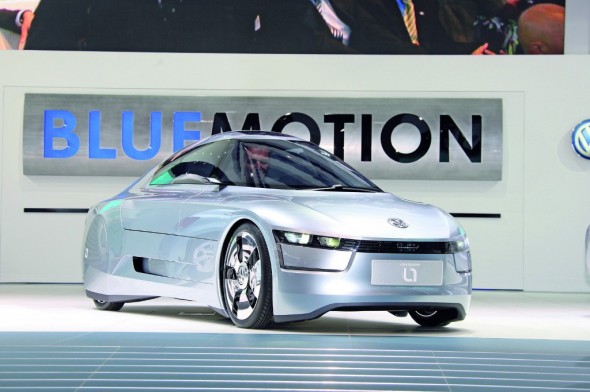
2009 Volkswagen L1 Concept 1.38 litres diesel per 100 km

Auto Car | 2009 Volkswagen L1 Concept 1.38 litres diesel per 100 km | Volkswagen presents the most fuel-efficient automobile in the world
- L1 Concept is driven by new high-tech TDI and E-motor
- Carbon Fibre Reinforced Plastic body of the L1 weighs just 124 kilograms
- Maximum speed 160 km/h; L1 consumes just 1.38 litres diesel per 100 km
- CO2 emissions reduced to a new best value with just 36 g/km

Wolfsburg / Frankfurt, 14 September 2009 – Technological breakthrough for the 1-litre fuel consumption car: International Motor Show (IAA), Volkswagen is presenting the concept of the future L1 in a world premiere that points the way toward the production version. The full hybrid vehicle weighs just 380 kilograms thanks to its carbon-fibre reinforced body (CFRB). With a combined fuel consumption figure of 1.38 litres of diesel per 100 kilometres, this extremely aerodynamic (Cd 0.195!) Volkswagen suitable for everyday use is intended to become the most fuel-efficient automobile in the world. CO2 emissions of the 160 km/h L1 are similarly low at 36 g/km.

Retrospective: Seven years ago, Dr. Ferdinand Piëch, at that time Chairman of the Board of Management and today Chairman of the Supervisory Board of the Volkswagen Group, drove a prototype from Wolfsburg to Hamburg that was unlike any other car before it: the Volkswagen 1-Litre car – the world’s first car with fuel consumption of one litre fuel per 100 kilometres. The man and machine wrote automotive history. In April 2002, however, it was also clear that the time for a production version of the 1-Litre car lay far in the future. Production of the body itself – from carbon-fibre reinforced plastic (CFRP) – was not realistic due to cost considerations. Yet, in 2002 Dr. Ferdinand Piëch already prophesised that the time would soon come for the 1-Litre car and CFRP as a material for industrial applications. By 2009 the time had come: Volkswagen is making a clear statement at the IAA in Frankfurt (September 17 to 27) with the second generation of this ingenious car: The L1 represents a step forward into the future with completely new technology and a new design; revolutionary yet close to production readiness.

“It is an enormous challenge to control costs in producing the monocoque out of CFRP,” says Dr. Ulrich Hackenberg, member of the Board of Management for the Volkswagen Brand with responsibility for development. Both technically and visually, the CFRP body is already considered a significant achievement in car design. Unique on this car are the proportions of its dimensions. While the length of the L1 at 3,813 millimetres is still similar to that of a Volkswagen Fox, and its height of 1,143 millimetres nearly matches that of a Lamborghini Murciélago, the car’s aerodynamically optimised width (1,200 millimetres) has no comparisons in the world of today’s production cars.

In developing both prototype generations of the L1, Volkswagen simply questioned everything that typically characterised an automobile. The key starting point was body construction, and a core question was raised here: How would a car have to look and be built to consume as little energy as possible? The logical answer: extremely aerodynamic and lightweight. Yet these objectives had to be achieved under a non-negotiable precondition: a maximum of safety. The approach taken: a narrow two-seater with a CFRP body!

The seat layout fitting this design goal was dictated by the uncompromising aerodynamic form of a glider: One seat behind the other. Entry to the concept car is also similar to that of a glider; through a roof cover hinged at the side. On this second generation of the L1, the concept has been further honed; each component has been redesigned, a special chassis with aluminium components was developed, and above all the crucial CFRP technology from Formula-1 racing and airplane construction was transferred to automotive manufacturing. This has been combined with a unique form of hybrid drive to create a near-production vehicle. 2013 is the target year for this future dream to become a reality.

The L1, equipped with ABS and ESP, has a top speed of up to 160 km/h – this is remarkable considering its fuel efficiency. With maximum acceleration from a standstill, the two-seater reaches 100 km/h after just 14.3 seconds. The fuel tank holds just ten litres yet, this is sufficient for a theoretical driving range of about 670 kilometres, given the car’s 1.38 litre average fuel consumption.

Source : www.distrocar.com
Read More..

2009 Volkswagen CC Gold Coast Edition

Auto Car | 2009 Volkswagen CC Gold Coast Edition |  To kick off the market launch of the new CC, Volkswagen of America, Inc. will debut a CC Gold Coast edition at the Pebble Beach Concours d’Elegance, August 15-17. The CC Gold Coast highlights the luxury sports coupe with powerful performance, strong lines and luxury touches combining the emotional and expressive stance of a sports coupé with the convenience of a luxury sedan.

“The CC Gold Coast builds upon the luxury sports coupe that debuted at the 2008 North American International Auto Show,” said Derek Jenkins, Chief Designer at Volkswagen’s Santa Monica, California Design Center. “We’ve added luxury and performance extras like tri-coat paint, high-end interior appointments, and ground affects that enhance the sportiness of our newest sedan.”

The unmistakable Volkswagen front-end, with two cross-struts and a centrally placed Volkswagen logo between trapezoidal headlamps is highlighted by the ground effects on the CC Gold Coast. A high-end tri-coat paint, DuPont’s Pepe Pepper, features a rich mix of gold, brown and silver tones that compliment the cars design characteristics.
The rear end of the coupé is also marked by large-surface dual taillights that produce an unmistakable visual image day and night. A spoiler with additional rear-end ground effects helps further enhance the vehicle’s sporty nature. The CC Gold Coast sits on 19 inch propeller style wheels, which provide a combination of sharp style and improved curb appeal.

Volkswagen’s attention to detail is shown off in the interior of the CC Gold Coast with four ergonomically formed sport seats wrapped in luxurious leather, a combination of Latte Macchiatto, Cornsilk with Bronze Piping on the seats with matching accents on the dash and door trim.
The CC Gold Coast edition features the 3.6L TFSI, rated at 280 horsepower and 265lbs.-ft of torque, with the innovative DSG double-clutch 6-speed automatic transmission with Tiptronic, yet another example of the car’s dual nature. The DSG system not only offers the driver the advantage of choosing between fully automatic operation or full manual selection, DSG also changes gears more quickly and smoothly than a conventional transmission, while improving fuel economy.

Source : digiads.com.au
Read More..

2010 Volkswagen New Compact Coupe Concept

Auto Car | 2010 Volkswagen New Compact Coupe Concept | For Volkswagen this marks the beginning of an action-packed year, in which more new models will be introduced than ever before in the company's history. Number 1 on the spectacular list of new products for calendar year 2010 is a car based on entirely new concepts and technology, a coupe with a hybrid drive that is extremely fast and yet futuristic in its fuel economy. It has sports appeal and sharp styling yet is remarkably elegant - positioned between the Europe's bestselling sports car, the VW Scirocco, and the internationally successful CC. Its name: the Volkswagen New Compact Coupe Concept. Site of its world premiere: Detroit, North American International Auto Show (January 11 to 24, 2010). Combined fuel consumption: 4.2 l/100 km (45 mpg)! CO2 emissions: 98 g/km! Incredible, considering its fuel economy, are its top speed of 227 km/h (141 mph) and the short 8.6 seconds it needs for the classic sprint to 100 km/h (0-60 mph in 8.1 seconds).

These values were made technically feasible by a high-tech alliance: a TSI engine (gasoline powered with 110 kW / 150 PS) that is as fuel efficient as it is sporty, an electric motor (20 kW / 27 PS) and a 7-speed Direct Shift Gearbox (DSG) - which in the eyes of many car drivers is the best automatic in the world today. Just over a month after the debut of the most fuel-efficient four-seater in the world - the VW Up! Lite in Los Angeles - this new concept car confirms once again that future Volkswagen hybrid vehicles will not only focus on fuel economy, but - similar to pure gasoline and diesel versions of Europe's most successful automobile brand - will also aim to be sporty and fun to drive. In the first half of the year, Volkswagen will launch its first hybrid model on the market under the VW label - an SUV with full-time all-wheel drive. Meanwhile, the Volkswagen New Compact Coupe Concept shows, both technically and visually, how Volkswagen envisions a front-wheel drive hybrid for the compact class that would be implemented when the time is right.

The concept car is driven by an extremely innovative high-tech alliance that closely approximates potential production versions. Volkswagen is using a four-cylinder version of the TSI gasoline engine range here. Direct injection, turbocharging and intercooler generate a power of 110 kW / 150 PS from just 1.4 liter of engine displacement - downsizing at its best. TSI technology has impressively demonstrated its extreme durability in many car racing events; including on the legendary Nordschleife of the German Nürburgring - the most demanding race course in the world. Since the first TSI engine was introduced just over five years ago, 3,5 million units of these boosted and torque-strong four and six cylinder engines have already been installed in vehicles. The TSI of the VW NCC - which of course is also equipped with ESP - transfers a hefty 220 Newton-meter (177 ft-lb) of torque to the front wheels at low engine speeds.

An electric motor is integrated between the TSI and the efficient 7-speed automatic (DSG = Direct Shift Gearbox); it can be used for pure electric emissions-free driving, or it can support the TSI with aggressive torque. The electric motor develops a power of 20 kW / 27 PS. The power and torque of the two drive units supplement one another during what is known as boosting - when accelerating to pass, for example. Since the VW NCC can also be driven in a pure electric mode, the drive system is classified as a Full Hybrid. A lithium-ion battery (1.1 kWh) at the rear of the vehicle supplies the electric motor with energy. By the way, in electric mode the TSI is not only shut off; it is also disengaged by a clutch to avoid drag losses.

 
Source : www.netcarshow.com
Read More..

2001 Volkswagen Magellan Concept

Auto Car | 2001 Volkswagen Magellan Concept |  The concept car, named after the Portuguese navigator Magellan, has a W8 engine with a power output of 202 kW / 275 bhp. It has four-wheel drive and pneumatic suspension with active hydraulic shock absorption.

The team at the Volkswagen Design-Center Europe in Sitges near Barcelona has brought together the emotional appeal of modern SUVs, the versatility of MPVs and the agility of an estate car. The length (4,685 mm) and width (1,860 mm) of the Magellan are that of an SUV. Its height (1,620 mm) defines a new type - the concept car is lower than an SUV or an MPV, but higher than an estate car.

Its off-road qualities are demonstrated by emphatic wheel arches, 19-inch six-spoke wheels with 245 Michelin tyres, good ground clearance, short overhangs and a relatively long bonnet. Estate car features are harmoniously integrated, underlining the crossover principle. These features include a steeply raked windscreen and, in contrast to SUVs, a low silhouette in the style of sporty estate cars. The MPV aspects are expressed in the car's width and height, its clarity and interior design.

Source : www.conceptcaronline.com
Read More..

1968 VW Beetle w/Roadrunner

Auto Car | 1968 VW Beetle w/Roadrunner | The Beetle is perhaps the best-selling car of all-time. Truly, a recognizable shape that has stood the test of time. The vehicle is still being produced in Mexico, continuing the long-time running record.

Adolf Hitler was searching for a people's car that was capable of transporting three children and two adults at speeds of sixty miles-per-hour. The car was to be inexpensive, costing the same as a motorcycle. Ferdinand Porsche was commissioned to produce such a vehicle.

There are many theories as to where the designs originated from. Some believe Hitler designed the vehicle. Some theorize that it was Joseph Ganz's 1920 design that was the true inspiration for the Beetle design. Porsche had created designs for the Mercedes-Benz 170H, which played into the design of the Beetle.

Inspiration for the Beetle had been drawn from the Tatra vehicles, mainly the T97, that had been designed by Hans Ledwinka. Due to the similarities, Tatra launched a lawsuit which never really materialized due to Germany invading Czechoslovakia. The lawsuit was later re-opened after World War II and Volkswagen was forced to pay Tatra 3,000,000 Deutsche Marks. This left Volkswagen with little money for development of new Beetle models.

The Volkswagen Beetle first came on the scene in 1947, but they were known by a different name. KdF, short for Kraft durch Freude meaning 'power by joy', was designated to these small, gas-friendly vehicles. In English, the name Beetle was used. In German, they were known as Kafer, and in French they were called Coccinelle.

These little bundles of joy featured mechanical drum brakes and a gearbox void of synchromesh.

In 1949 the Volkswagen logo was placed on the rims. The engine was expanded to 1131 cc and was capable of producing 25 horsepower. The models that were produced after October of 1949 could be started without a 'starting crank'.

Two convertible options were offered by Volkswagen in 1949. The two-seater design, designated 14A, was penned by Josef Hebmuller. The four-seater Type 15 version was designed and produced by Karmann of Osnabruck. The four-seater was vastly more popular and stayed in production for 30 years.

The 14A was stylish and attractive, with the major shortcoming being a fire that destroyed the factory where they were being produced. The two-seaters featured a rear deck nearly identical to the front hood. The strength of the car, lost by removing the roof, was amplified by a stronger windshield frame and dual Z-section girders located under the floor. In 1953, the last of the Hebmuller rolled off the assembly line, after only 696 examples were produced.

In a time when practicality ruled over style, the four-seater cabriolet was king. The Karmann company had a long history of designing and building cars. In business since 1901, was familiar with assembly line production, benefits and features of different types of metals, and the styles of multiple markets.

The mechanical, cable-driven brakes were replaced with hydraulic brakes in 1950.

During the 1950's the Beetle saw exterior and interior improvements. 1951 saw the addition of arm-rests which were discontinued just a few months later. In 1952, 2nd-4th gears became synchronized. The dashboard was redesigned with a glove compartment. In 1955, the bumper was improved and electrical direction-indicators were installed. A second tail-pipe was added. The front seats became wider and could be moved to three different seat-back adjustable positions.

In 1956, the tires became tubeless. Near the end of '56, side view mirrors became standard on all Beetle models.

In 1957 the front window was increased by 17 percent while the rear window received a 95 percent increase. A new dashboard, rear view mirror, radio, and a speaker appeared. The turn signals would now turn-off automatically.

Up to this point, a roller pedal had been used to initiate acceleration. This was the year that the gas pedal replaced the roller pedal.

In 1958, ivory disc wheels were offered.

In 1960, an engine capable of producing 34 horsepower was offered. The speedometer was increased from 74 mph to 87 mph. A windshield-wiper washer system became available. The front directional light was changed from white to amber.

A gas gauge was added in July of 1961.

In 1963, the seats were changed from wool upholstery to synthetic. The VW emblem located on the hubcap was no longer painted. The safety of the vehicle was once-again enhanced with the enlargement directional lights.

There were minor changes in 1964. The windows did, however, become larger.

In 1965, the front axle was improved. The ongoing saga of incremental improvements received another chapter - A defroster vent was added to the center of the dashboard.

The Beetle continued to be sold in the United States until 1978 with the convertible version was sold until early 1980. Sales continued in Europe until 1985. Developing countries, such as Mexico, have been developing the Beetle since 1964 and the vehicles have remained in production since that time.

Source : www.conceptcarz.com
Read More..

1979 Volkswagen Beetle 1303

Auto Car | 1979 Volkswagen Beetle 1303 | It wasn’t until 1948, well after the war had ended, that Ferdinand Porsche got around to doing what he had always wanted to do: create a world-class sports car under his own name, dubbed the Porsche 356. From there the marque has grown into the performance car giant that we all know and love today. So what happens when you combine Ferdinand’s two greatest achievements, the ultra-budget Beetle and the super-expensive Porsche? You get this: Mark Walsh’s 1979 Volkwagen 1303.

This immaculate machine is a melting pot of economy and prestige, hippy and yuppie, good times and racing prowess. Ninety percent built by friend John Kanter over the last decade before he sold the car to Mark, the VW is beyond immaculate and, more importantly, now runs about as much Porsche gear as it does Volkswagen.

Originally from California, this 1979 Super Bug was imported into the country many years ago as a stolen and recovered wreck lacking any interior, gearbox or engine. John somehow found the car in the mid ’90s sitting under a tree out in the countryside, quietly rusting away. Deciding to save the Bug from certain death, John purchased the car and began the very long, painstaking process of rebuilding the Volkswagen.

Being a left hook US example, many hours were spent converting the car to right hand drive, while the rusted floor was also chopped out and replaced with a brand new one. Coming from California, where the air tends to be a lot drier than the rest of the country, the VW’s body was in surprisingly good shape, although John still pulled the whole car apart and sandblasted every panel. Before putting the Beetle back together, the rear guards were widened a full inch on each side, and the side indicators were also deleted.

A custom Glasurit green/blue hue was chosen to coat the now perfect panel work, and along with all new re-chromed bumpers, a custom-made soft top and Audi windbreaker, the car was starting to look like something a little special. If you look carefully, you might notice a pair of very rare headlight washers mounted on the gleaming front bumper. These powerful sprayers were only ever sold on VWs in Sweden, and apparently are quite a collector’s item to Beetle aficionados. Put the car on a hoist and look underneath and things are just as spectacular. The super-clean underbelly also has a latticework of bracing, designed to stiffen up the chassis and stop wheel shudder under heavy launch.

Mark’s Beetle looks amazing in the flesh, but what really sets it apart is what lies underneath that deep, lusty skin. Sitting just above the rear wheels, in place of the original 1600cc four-cylinder VW motor, is a Porsche Type 4 2-litre engine pulled from a Porsche 914. Before John mounted the engine into the tiny boot space, he pulled the motor apart to add a stroker crank and slightly larger 105mm pistons. The head has also been ported and polished, and uses big valves and a round exhaust port conversion to aid flow. Extra cooling ability has been added by the addition of a front-mounted oil cooler and Porsche 911 12-blade fan. Originally a carburetted engine, Mark’s Type 4 now runs a full Haltech F9A computer, transforming it into a howling, fuel injected beast, pumping out 200-odd horsepower.

To keep things as quiet as possible, a very nice custom alloy air box encloses the twin 50mm throttle bodies in an effort to reduce induction noise and add power, while a set of equal length headers and a short custom-built exhaust system extract waste gasses in as quiet a manner as possible. Of course, those couple of hundred ponies don’t have far to gallop on their way to the road, reaching the rear Porsche 911 Turbo Twist Cup rims – wrapped in 205/40R17 rubber – with little complaint. This is thanks to a very strong 911 5-speed gearbox, mated to a 914 flywheel and heavy-duty clutch. Looking through the large gaps in those awesome 911 rims, you will notice that the brakes are also of the Porsche variety.

Source : www.performancecar.co.nz
Read More..