Showing posts with label Hyundai. Show all posts

2/27/11

Hyundai Hellion Concept 2006


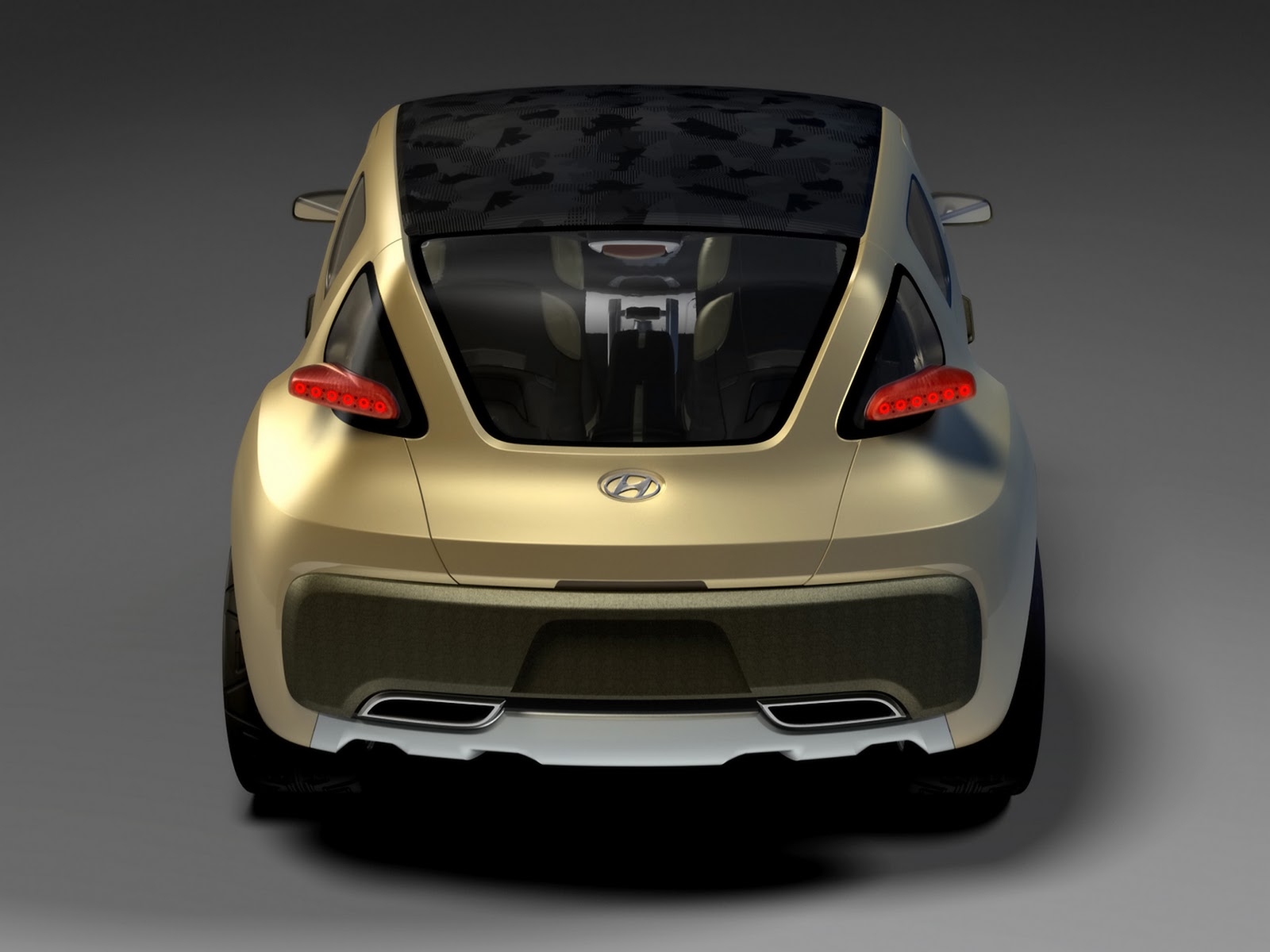
Auto Car | Hyundai Hellion Concept 2006 | Hyundai is a company which is rapidly trying to make over its image as a purveyor of entry-level, inexpensive basic transportation. With the announcement of new luxury coupes and sedans targeting the likes of Lexus and Infiniti, and with excellent quality marks from independent reviewers and an extremely comprehensive warranty, Hyundai is poised to make their leap into the future. This desire to break with the past is evident in some of the concept cars that they have been displaying around the world’s automotive shows. One such vehicle is the 2006 Hyundai HCD10 Hellion Concept.


The HCD10 is a 2 door crossover SUV that looks sort of like a truck and sort of like a hatchback. Hyundai claims that the vehicle’s exterior styling was inspired by a ‘hard shell backpack’, and while that seems a bit too bizarre to be believed, a backpack is not an inaccurate metaphor for what the 2006 Hyundai HCD10 Hellion Concept brings to the table. Given its small size but rugged shape, the HCD10 would indeed be perfect for a weekend foray into the wilderness provided you didn’t need to bring along too much kit with you.


The front end of the Hellion Concept is somewhat bland, with a gently sloping hood framed by flared fenders that greatly resemble the Suzuki SX4 rally racer. Awkward looking doors give way to another flared rear section, and the hatch of the Hellion is located just above the large rear bumper. Interestingly, the roof is made of fabric and can be lifted off the reveal a skeleton of cross members that keep chassis stiffness at a safe level. Hyundai calls these ribs a ‘safety cage’, and they are visible from inside of the vehicle regardless of whether the top has been installed or not.


Inside the car, an LCD monitor entertains rear passengers while backpacks mounted on the rear of each seat can be released and used to actually carry items outside of the car itself. The Hellion also provides a ‘fluid reservoir’ for each seat which can be filled with the beverage of your choice and then accessed through an attached drinking tube. Just how sanitary this entire arrangement is, or what happens when you forget to empty the reservoirs before parking overnight in sub-zero temperatures was not explained.


The 2006 Hyundai HCD10 Hellion Concept is powered by a 3.0 liter diesel V6 making 236 horsepower and 332 lb-feet of torque. Electronic stability control, wireless internet and adaptive cruise control can also be found in the concept. A six-speed automatic transmission handles the shifting duties, and of course this off-roader is equipped with all-wheel drive.


It is fairly obvious that the 2006 Hyundai HCD10 Hellion Concept will most likely never be built or sold to the general public. However, it does indicate that Hyundai is interested in the mini-off road market that has been largely ignored ever since the Suzuki Samurai and Geo Tracker faded into the past.


These vehicles remain popular with drivers on the trail because of their short wheelbase and light weight, two features which make them highly maneuverable, especially when faced with obstacles in nature. Hyundai representatives also revealed that they find ‘mindset and attitude’ to be important factors when defining new automotive markets. While this may be partially true, efforts to sell vehicles in the past based entirely on the concept of ‘lifestyle’ have not traditionally met with a great deal of success. It would perhaps be better for Hyundai to remember that most often it is mindset and attitude within a market segment that is one of the primary determinants of success.

Source : www.sport-cars.org
Read More..

Hyundai QarmaQ 2007


Auto Car | Hyundai QarmaQ 2007 | Hyundai has presented at the Geneva Show the series model i30 hatchback and the new QarmaQ concept.The crossover Concept, which has been announced in a sketch published a few weeks ago by Hyundai, brings an important change of approach in what concerns the materials used in its composition.


While the traditional cars use metal and glass, QarmaQ is assembled from plastic materials made by GE Plastics. The QarmaQ concept is the result of the cooperation between the 2 companies and brings, as novelty, a vista of the kind that only a view from the chopper gives, because of the great surface of the plasticized windows from the car's body.


By integrating GE's polycarbonate glazing wrap-around and the GE Lexan windscreens, the body weight of the cars is reduced by almost 50 %. A unique technology characterizes Lexan screens: Exatec Technology. It' s a technology through which a thin, protective layer of glass is deposited on the screen, which helps when protecting from scratching or effects of humidity. The material, much lighter than traditional glass used in automotive industry, also increases the impact resistance and both occupant and pedestrian safety. When talking about pedestrian safety, we can also mention the system that uses deformable sections under the concept's body panels, which is able to absorb crush energy in case a collision with a person may happen.


GE Plastics' High Performance Thermoplastic Composite (which is used for the horizontal body panels) manages to also save some weight. 900 recycled plastic bottles have been used when manufacturing other body panels.


The new concept is a showcase of 30 new technologies that will be found in the future Hyundai models. The car is the result of the hard work of Hyundai Motor Europe's Design and Technical Center and it has been engineered in cooperation with GE Plastics. It will be ready to roll in 2008 to 2014.


Source : www.thesupercars.org
Read More..

Hyundai Veloster Concept 2007


Auto Car | Hyundai Veloster Concept 2007 | Hyundai unveiled three new vehicles at the Seoul Motor Show, and the first we'll talk about is the sporty-looking Veloster coupe concept. According to the PR materials, the Veloster has potential Gen-Y shoppers in its sights, and to be sure, it's an attractive little coupe. The trapezoidal grille opening reminds us a lot of the new Mitsubishi Lancer / Evo X, and the overall shape is similar to a number of other vehicles in this class. The roof is mostly glass, with a metal, bodywork-colored "mohawk" running through the middle. The CHMSL that's integrated into the tail end of the "mohawk" behind the rear glass is a slick touch. The triangular, shoulder-mounted taillamps and single, center exhaust outlet add some flair to the car's posterior.


Inside, a terrific-looking retro/modern interior incorporates neat features such as an iPod dock in the center console and an Engine Start button on the top of the shift knob. Power comes from a 2.0L four-cylinder that drives the front wheels via a 5-speed manual. Whether or not the study will eventually amount to anything on the consumer side is anyone's guess, but as concepts go, it's fun without being totally outlandish.


In a demonstration of its growing design and engineering capabilities, Hyundai Motor Co. unveiled three brand-new models at the 2007 Seoul Motor Show which opened at KINTEX today. Leading the trio was the Veloster, a sporty coupe which caters to the unique requirements of the Y-generation. Joining the sporty concept car were two production models: the TQ van, a thoroughly fresh interpretation of Hyundai's hugely successful H-1 van and the FD estate wagon, styled at the company's European Design Center in Russelsheim which marks Hyundai's long-awaited return to this popular segment.


Veloster
Styled at Hyundai's Design and Technical Center at Namyang, the Veloster (codenamed HND-3) coupe is the third in a series of daring concept cars to be developed by the central styling studio in Korea. The Veloster name, a compound of velocity and roadster evokes the sporty characteristics of a classic two-plus-two. A panoramic glass roof and other futuristic styling cues help project a high-tech image.


Designed to cater to the tastes of the Y-generation, Veloster combines simple, iconic design with good value and robust construction.
"With Veloster, we wanted to try something really different. We're keenly aware that we need radically new products for the Y-generation, the first-time twenties something buyer," said Oh Suk-Geun, Hyundai's vice president of design. "This is really a bold new direction," he added.


Source : www.autoblog.com
Read More..

Hyundai HED-5 i-Mode Concept 2008

Auto Car | Hyundai HED-5 i-Mode Concept 2008 | Hyundai is proud to introduce a new concept car which hints at a future MPV production model and showcases advanced technologies. The Hyundai HED-5, named "i-Mode" is a six-seater people carrier that incorporates high-tech materials, an advanced seating concept and state of the art communication technology in a completely new vehicle.
By working together with the partners Bayer MaterialScience AG, Keiper and LG Electronics, Hyundai is continuing a cross-industry co-operation to drive new technologies faster to market.


The co-operation with Bayer MaterialScience enabled the radical design of the Hyundai HED-5 to be implemented more quickly. The materials used are lighter and more adaptable than the metal and glass they replace. This, in combination with a light weight body construction, reduces fuel consumption and CO2 emissions. Self-healing water based bodywork finishes from Bayer add to the environmentally friendly concept of the vehicle and even let minor scratches magically disappear by themselves. The i-Mode is the first vehicle to feature the new "BayVision" glazing system and Collimator headlight lenses made from Makrolon®.


Through the advanced entertainment concept developed by LG electronics, the vehicle becomes an extension of the digital home, allowing passengers to stay connected, communicate and interact in the car. Access to the web, video games, movies or video calling are all possible through the pop-down touch-screen displays and webcams, located within the overhead console. A wireless network enables a selection of cable-free keyboards, game controllers and headphones to further personalise the entertainment experience. The advanced developments seen on the i-Mode give a dynamic indication of real possibilities for the near future.


Hyundai's engineering partner Keiper supported the i-Mode project with the exclusive world premiere of its new and unique Swivel Seat concept. The first row passenger seat rotates to face second and third row occupants. When the seat is turned, the backrest converts into a comfortable seat surface. This is made possible by a fully concealed, power-operated kinematic system. The integrated seatbelt system - another technically advanced debut - and the adjustable headrest maximize passive safety for passengers in either sitting position. The second row bench slides rearwards to increase comfort and create a social area.


The Hyundai HED-5 i-Mode concept demonstrates the increasing awareness Hyundai has towards environmental issues. Cooperation with Bayer Material Science has seen use of the innovative glazing alternative 'Makrolon', enabling the car to have extended transparent areas, reducing weight and increasing fuel economy.


The Hyundai HED-5 "i mode" includes the hexagonal shaped grill, which symbolises the new brand identity for Europe. This feature, previously showcased on earlier Hyundai concept cars, demonstrates the consistency in developing a coherent design language. It is through such characteristics that Hyundai aim to enhance the perceived quality and recognition of their products.
Through the door opening mechanism, the interior is in the form of a lounge compartment. The interior represents the concept of social space, an environment where all occupants can enjoy safe travel in comfort, surrounded by sophisticated technology and luxurious materials.


Attention is immediately drawn to the seats, which offer first class comfort for all occupants, combining a modern look with innovative functionality. The Cognac leather cushions and the burgundy lacquered seat structure give the occupants a lounge atmosphere without the limitations of a conventional automotive interior layout.
The light beige headliner, which continues through into the pillars, provides the interior with a floodlit, almost roofless panoramic appearance. The horizontal trim colour division, between dark and light tones further emphasises this.


All-new R Diesel with Two-Stage Turbocharging
i-Mode is powered by an all-new 2.2-litre R diesel engine which first passes the intake air through a low-pressure turbocharger from where it is forced into a high-pressure turbocharger for maximum boost: 158kw (215ps) and 47kg.m of peak torque (461 Nm). The R Engine has a power density in excess of 70kw per litre putting Hyundai diesel technology in the same class as any leading German automaker. When its low-end torque of 30kg.m is compared with the 19kg.m of low-end torque delivered by the standard R Engine, one quickly appreciates the value of dual-stage turbo charging.


The R Engine is a smooth-shifting 6-speed automatic gearbox. Even at maximum loads, the engine does not incur fuel consumption penalties thanks to its high capacity for exhaust gas recirculation that also benefits efforts to reduce NOx emissions. The R Engine is assured of meeting future, more stringent EU exhaust emission standards. Mass production of the R Engine is scheduled to begin with the standard (single turbocharged) version in 2009 with the dual-stage turbocharged edition arriving in the first half of 2011.

Source : get1car.com
Read More..

GReddy X-Gen Street Hyundai Genesis Coupe 2009


Auto Car |  GReddy X-Gen Street Hyundai Genesis Coupe 2009 | The Korean car builder Hyundai is enjoying unrivaled success with their Genesis Coupe when they introduced a few modified versions of their new sport compact last year at the world’s greatest aftermarket auto show, the Specialty Equipment Market Association convention that takes place every Fall in Las Vegas. While most automakers are pulling out of these kinds of ventures due to the global economic crisis Hyundai is one of the only retailers that is in the black. So in an attempt at following up last year’s trio of SEMA show cars, Hyundai will be well represented this November at the Las Vegas Convention Center with a few new tuner creations.


Hyundai’s latest endeavor is in cooperation with the Japanese high performance aftermarket parts manufacturer GReddy to create the X-Gen Street Genesis Coupe. While Hyundai was in charge of providing a solid foundation, it is the list of items from the Greddy Performance Parts catalog that will make this a true tuner car. The program started with a coupe powered by Hyundai’s 2.0 Liter turbocharged four cylinder engine that in standard trim produces a maximum output of 210 HP and gets 30 MPG has been retooled to make a tire shredding 350 HP and 320 lb-ft of torque.


The exterior of the GReddy Genesis Coupe is made to look a bit more aggressive with an Aero lip spoiler, carbon fiber hood, stylish rear spoiler, light weight Volk Racing G2 wheels wrapped in a set of sticky Toyo high performance rubber. Artists from Hyundai’s North American Design Center in Irvine, California are responsible for the Greddy Genesis Coupe’s unique finish while inside the team has fitted a set of Sparco racing buckets, a modified gauge cluster as well as the all important boost controller to add a little extra pressure into the mix and a turbo timer to ensure that the turbocharger lasts long into the future all controlled by one of Geddy’s remote switching systems in order to eliminate any unnecessary tangles. On a more personal note, this Greddy creation looks a while lot better than last year’s HKS interpretation.


Source : www.topspeed.com
Read More..

Hyundai DUB Magazine Genesis Sedan 2009


Auto Car | Hyundai DUB Magazine Genesis Sedan 2009 | Hyundai manufactures three engines for the Genesis sedan and offers the car internationally with various combinations of the three:
The Tau V8 is Hyundai's first homegrown eight cylinder engine. For the 2008-09 model years, the 4.6 L engine produced 375 horsepower (280 kW) at 6,500 rpm and 333 lb·ft at 3,500 rpm.[12] Introduced as a midyear change for the 2010 model, the 4.6 L V8 now produces 385 horsepower (287 kW) at 6,500 rpm, with no change in the torque output: 333 lb-ft at 3,500 rpm. These figures are achieved using premium fuel. The V8 can also run on regular unleaded, in which case the 2010-11 model produces 378 horsepower (282 kW) and 324 lb-ft. For the V8 model, Hyundai has reported 0-60 mph times of less than 6 seconds. Car and Driver reports a 0-60 mph time of 5.3 seconds,[15] while Motor Trend reports a 0-60 mph time of 5.5 seconds in their October 2008 issue.


The Lambda 3.8 L V6 is available in Korean and North American models. In Korean spec, the engine produces 306 horsepower (228 kW). In US spec this engine produces 290 hp (216 kW) at 6,200 rpm and 264 lb·ft (358 N·m) at 4,500 rpm. Motor Trend reports a 0-60 mph time of 5.9 seconds.
The Lambda 3.3 L V6 is available in some markets, producing 264 horsepower (197 kW).
In North America, the V8-powered Genesis features a standard ZF 6HP26 6-speed automatic transmission from ZF Friedrichshafen (identical to the unit found in the BMW 5-Series), with the base V6 models receiving the 6-speed automatic Aisin transmission also found in the Hyundai Veracruz. All three engines can run on regular gasoline, an exception to most high-performance, high-compression engines that require premium fuel.


Standard features on all models in the US include cruise control, automatic headlights, dual-zone automatic air conditioning, leather seat-upholstery and steering wheel, heated front seats with power adjustments, power windows, door locks, and mirrors, remote keyless entry and starting, and a seven-speaker audio system with XM satellite radio.
An optional Lexicon audio system offers 7.1 channels, 528 watts output, 17 speakers, two 3-way transducer systems, five 2-way transducer systems and digital signal processing that provides equalization among driver and passengers. The Rolls-Royce Phantom and the Genesis sedan are the only automobiles to offer the Lexicon audio system.


The Hyundai Genesis utilizes a speed-sensitive rack-and-pinion steering, and comes with four-wheel disc brakes. The suspension is a multi-link setup in front and a 5-link setup in the rear. Weight distribution is 53% front / 47% rear for the V8 and 52% front / 48% rear for the V6.
Standard safety features include dual front airbags, front and rear side airbags, side-curtain airbags, ABS, brake assist, EBD, traction control, and electronic stability control.

Source : en.wikipedia.org
Read More..

Hyundai Genesis Sedan 2009


Auto Car |Hyundai Genesis Sedan 2009 | The debut of the ’09 Hyundai Genesis at the 2008 Detroit Auto Show just might prove that the Korean carmaker can play hardball in the premium sport sedan market. But how will the public receive its styling? With less-than-subtle references to Acura and Infiniti inside and out, we’re not sure if the Genesis is distinctive enough to stand out in this very competitive segment. But considering its impressive spec sheet and, more remarkably, its sub-$30,000 price tag, Hyundai’s big new entry will offer a lot of car for not a lot of cash when it goes on sale this summer—unparalleled value in an upscale


Hyundai crafts a rival to the world’s premier sports sedan. Rear-wheel drive and high-output V8 engine deliver world-class driving experience.
Hyundai aims to shatter premium automobile paradigms with the North American International Auto Show introduction of its new flagship, the all-new Genesis sports sedan. With capabilities and features comparable to the world’s leading premium sports sedans, Genesis will arrive at Hyundai dealerships this summer.


Genesis is built on Hyundai’s all-new, performance-driven rear-wheel-drive architecture. It offers three powertrains, including 3.3-liter and 3.8-liter V6 engines, and Hyundai’s all-new 4.6-liter Tau V8. The Tau will produce an estimated 375 horsepower using premium fuel and 368 horsepower using regular unleaded leading all competitors in specific output with 79.5 to 81.0 horsepower per liter. With technology rivaling more expensive luxury sedans, Genesis showcases features such as XM NavTraffic, Adaptive Front Lighting System (AFLS), Smart Cruise Control, Lexicon® audio systems and electronic active head restraints (for a full list of leading features, see page 8).


“While Genesis will compete for customers with cars like Chrysler 300 and Pontiac G8, our engineering benchmarks were Mercedes E-Class, BMW 5 Series, Infiniti M, and Lexus GS,” said John Krafcik, vice president, product development and strategic planning, Hyundai Motor America. “Genesis provides a potent combination of performance, luxury, and value. We think it has the opportunity to be an extremely disruptive force in the large sedan and near-luxury segments.”
Genesis ushers in a new era for Hyundai. Its all-new rear-wheel drive architecture will spawn more products in other segments, as suggested by the Concept Genesis Coupe shown at the Los Angeles Auto Show in November 2007.


NEW PERFORMANCE-DRIVEN REAR-WHEEL-DRIVE ARCHITECTURE
Genesis is built on an all-new rear-wheel-drive architecture, its first application in a U.S. Hyundai model. Genesis boasts a near ideal 53/47 front-to-rear weight distribution for exceptional handling and more refined steering characteristics. The rear-wheel-drive layout allowed engineers to position the car’s front wheels farther forward delivering outstanding handling and steering performance. Standard Electronic Stability Control (ESC), the industry’s most important new safety technology, further enhances the vehicle’s driving confidence. Hyundai leads all popular car brands in the standard application of ESC, with more than 70 percent of 2007 Hyundai sales featuring ESC as standard equipment.


Genesis reduces interior noise levels and improves ride and handling with a stiffer, lighter body structure. The use of high tensile steel in critical areas in the unibody provides Genesis with 12-14 percent higher dynamic torsional rigidity and a lower body structure weight than the BMW 5-series and Mercedes-Benz E-Class – despite having a substantially larger cabin than either of those benchmarks. Hyundai Genesis has more interior volume than Mercedes Benz E-Class and BMW 7-Series.

Source : robson.m3rlin.org
Read More..

Hyundai Nuvis Concept 2009


Auto Car | Hyundai Nuvis Concept 2009 | Hyundai’s Nuvis Concept, making its world debut at the 2009 New York show, is yet another hybrid-crossover dream car designed to blend utility with small-car fuel-economy and sci-fi futuristic styling.


Penned at Hyundai’s design center in Irvine, California, its SUV-style body gives the Nuvis the passenger and cargo room of a large sedan, while its wide stance and low roofline lend it a sporty appearance. Powered by a parallel hybrid system backed up by a 270-watt lithium-polymer battery, the Nuvis delivers an estimated 34 mpg city and 35 mpg highway according to Hyundai, meeting the Ford Escape Hybrid’s city mileage and beating its highway mileage by four mpg.


Hyundai’s Hybrid Blue Drive system operates on a principle similar to Toyota‘s Hybrid Synergy Drive, wherein the gasoline engine is mated to an electric motor that reduces the load on the engine, increasing efficiency. In this case, Hyundai’s 228-hp Theta II 2.4L inline four-cylinder engine is mated to a 30 kW electric motor that can get the vehicle moving from a stop and provide extra power for accelerating and passing.


That’s no ordinary Theta II engine, either. The engine has been optimized to minimize efficiency-robbing friction, as has the entire drivetrain. Hyundai also massaged the engine management software for efficiency wherever possible in order to further boost fuel economy. Meanwhile, the fourth, fifth and sixth gears of the six-speed automatic transmission have been extended for better highway fuel economy. Hyundai says its lithium-polymer battery pack, stored under the rear cargo floor, is more space-efficient and durable than the nickel-metal hydride or lithium-ion battery packs of other hybrids. The smaller battery pack helps reduce weight as well, and the Nuvis tips the scales at just 3400 lb, according to Hyundai.


When you look at the Nuvis, though, fuel efficiency probably won’t be your first thought. Hyundai says the Nuvis draws many of its styling cues from the motion of running water, which makes it appear as though it’s always moving. While the lines themselves are graceful, a few too many of them run into each other for our taste. Things get cleaner as you work your way from the pinched nose along the sides to the back, where it’s less busy. Regardless of which angle you choose, though, it will be hard to miss a hint of Mazda’s Nagare design cues in the body lines.


Source : www.carvegasus.com
Read More..

RMR Red Bull Hyundai Genesis Coupe 2009


Auto Car | RMR Red Bull Hyundai Genesis Coupe 2009 | With enthusiasts eagerly awaiting the upcoming launch of the 2010 Genesis Coupe, Hyundai is adding to the excitement by teaming with Rhys Millen Racing and Red Bull Energy Drink to campaign the car in the high-energy sport of drift racing this year. At the Chicago Auto Show, Hyundai unveiled its motorsports program in the U.S. with the help of drift champion Rhys Millen, who will fabricate and race a 550-horsepower Genesis Coupe in the Pikes Peak International Hill Climb, the Formula Drift Professional Drifting Championship and at select Redline Time Attack series events in 2009.


“Today`s announcement puts the Genesis Coupe into three great motorsports series,” said John Krafcik, acting president and CEO, Hyundai Motor America. “We like to refer to the Genesis Coupe as the sinister sibling to the North American Car of the Year, the Genesis sedan and we look forward to Rhys harnessing every ounce of energy in the Coupe as he campaigns it.”


Millen and his team are an ideal match to launch Hyundai`s racing efforts. Millen`s driving credentials include movie stunts, multiple drifting championships, a Pikes Peak world record and his recent New Year`s Eve Las Vegas truck flip. But behind Millen`s success in the driver`s seat is a full team of engineers and fabricators that know how to maximize the potential of a race car.


Millen had his first opportunity to test drive the Genesis Coupe`s performance credentials when he performed precision driving for the car`s debut advertising campaign. Millen flogged a Genesis Coupe for three days during the filming process at Road Atlanta racetrack, and the car never missed a beat.


“The Genesis Coupe Concept inspired me to seek out a relationship with Hyundai and it has developed into multiple projects,” said Millen, professional race driver and founder of RMR. “The immediate focus is developing the RMR Red Bull Hyundai Genesis Coupe into a drift car with a 550-horsepower engine and a lightweight, rigid chassis. We are applying everything we know about fabricating into building this car.”


Source : www.lincah.com
Read More..